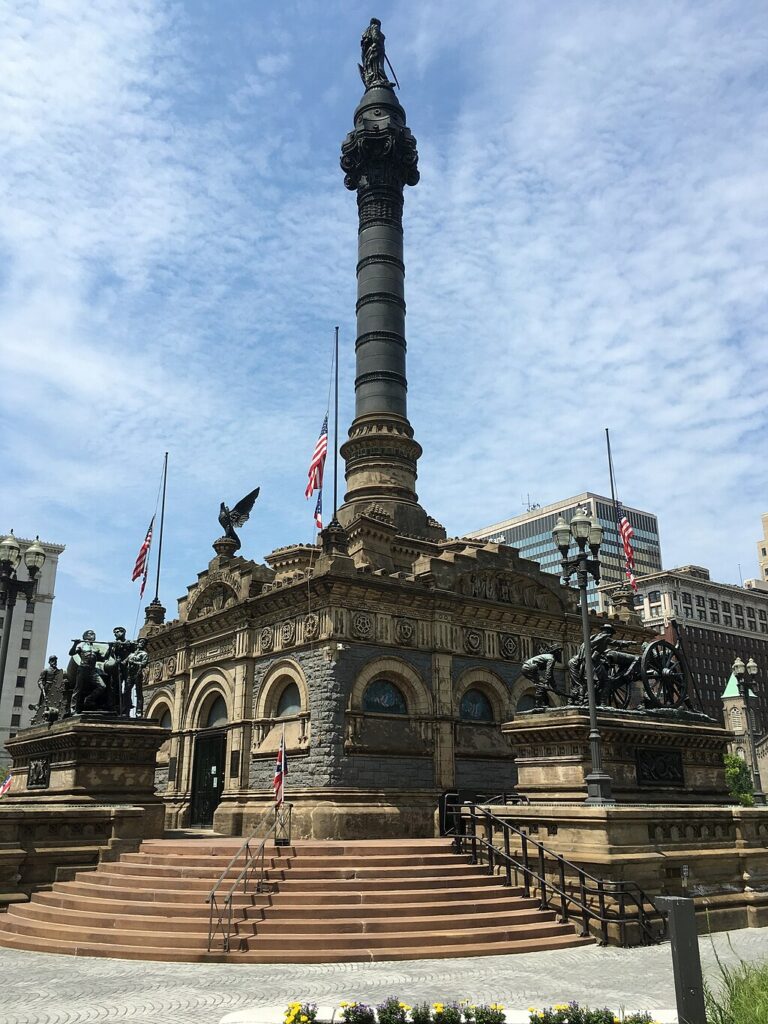
For my Spring 2025 internship course, I took an unconventional approach. I asked if the position that I already had could count towards my internship course. Last year, I got a job working at the Cuyahoga County Soldiers’ and Sailors’ Monument. I’m a part-time caretaker, which is essentially a combination of docent, janitor, archivist, and researcher. My daily duties consist of opening the memorial hall in the morning, keeping the memorial hall clean, without over-cleaning, picking up trash around the southeast corner of Public Square, educating visitors about the basics of the monument, keeping track of the artifacts currently on display, and working on my on-going research project.
First, for those of you not already in the know, the Cuyahoga County Soldiers’ and Sailors’ Monument is the Civil War monument for the county. It consists of an outer esplanade with four sculptures, a 150-foot tall pillar of black, Quincey granite capped by another sculpture, and a memorial hall. The inside of the hall is filled with more sculptures, and a series of marble tablets that list all 9,000 of the men from Cuyahoga that served as a Union soldier or sailor during the Civil War. The Monument’s memorial hall is open seven days a week from 10:00 am to 5:30 pm, completely free and open to the public. The only exceptions are a handful of holidays, cases of extreme weather, and Browns home-games. The latter decisions makes sense only after you have tried to catch a bus to downtown or to find a parking spot close to Public Square during a Brown’s game. If you are wondering where to find this magical place, it’s located at 3 Public Square. You’ve probably walked past it well over a hundred times, even if you’ve never gone in.
As I said, I started working at the Monument last year, right around October, and asked the department if it could count towards my internship requirement this spring. Since I work more than the required hours each week, and my duties were the sort you would expect to have working an internship at any small museum, the department accepted. However, due to starting the position before this took place, I’ll be talking about a few things that I learned and started doing before the “internship” officially began.
To start with, I learned that the Monument has very exact care requirements, which were developed by the same professional historians, tradesmen, and scientists that did much of the work on the 2008-2010 restoration of the Monument. No abrasive cleaning agents or acidic chemicals can be used while cleaning the monument. Marble is very reactive to even mild acids, and sandstone can crumble easily with too much friction or force. The sculptures, both inside and out, are all made of bronze and are coated with a layer of protective wax. So, they, and the handrails, need to be cleaned lightly with rags and water and a very, VERY soft-bristled brush. Mopping is to be done with warm water and the occasional gentle dish soap mixture. Rock salt is not to be used on the monument, instead a non-salt, pet-friendly snow-melt solution is to be used during the winters. Any signs of chipping, damage to the mortar, or extra dust is to be reported immediately and cataloged. Vandalism and biohazards must be cleaned with gentle cleaning methods and disinfected quickly. Why?
Because the Cuyahoga County Soldiers’ and Sailors’ Monument, while host to a collection of civil war artifacts, is an artifact itself. Many of the bronzes, bricks, and stone pieces were collected/created between 1888 and 1892, and the hall was originally built in 1894. Every piece of stone, every scrap of metal, every piece of glass, and every brick in the foundation is a piece of historical craftsmanship that cannot truly be replaced. Periods of poor care and improper cleaning methods used during the 20th century led to damage that can never fully be undone. Several of the marble tablets in the memorial hall are bent and bowing, due to humidity from the original steam-radiator heating system. Sculptures have had some details lost or polished away. As such, caretakers, and the Monument Commission and County Works employees and contractors, need to take care not to cause any more undo damage, and to keep on top of wear and tear from the Monument’s continued existence. Wear and tear that will happen, inevitably, because the Monument is a public building that people interact with, and which experiences weather.
I have also learned much about the Monument’s history. While I have been going into the memorial hall and interacting with the Soldiers’ and Sailors’ Monument since I was a young child, I only really learned the story of the Monument’s construction when I began to work there. The Monument’s story began in 1879, with a vote from the “Camp Barnett” Soldiers’ and Sailors’ Society to build a monument for the Civil War. The monument was then funded by a bill passed in the state legislature, which empowered the County Commission to levy a property tax and set up an account to deposit the funds. It also empowered a Monument Committee, then Commission, which would pick a place to build, pay contractors, and be responsible for the design. The Commission, even after gaining permission to build by the City of Cleveland, faced heavy resistance from the Park Commission of Cleveland and several business owners that had their own designs and plans for the Square. An injunction case went all the way up to the State Supreme Court, delaying construction. After the Monument was built, plans were made over and over through the twentieth century to tear it up, scrap it, move it somewhere else, and even to build a big, glass box over the whole monument that would obscure it. There are also many small stories attached to the Monument, such as names of famous families on the walls, the “Mad Locker” of the sixties, and various bits of folklore and their origins. All of this was fascinating to read about in books and pamphlets and letters written by the original builders, along with newspaper articles and other sources.
Learning this information was one thing, but learning how and when to communicate it was another. During my time at the Monument, I have found there are a few main types of visitors that walk in of their own volition. There are those that just wonder what is inside, see the sign, and walk in. They don’t want to learn much more than that the Monument is for the Civil War and that it is, indeed, open to the public. Their curiosity is satisfied by stepping inside. There are those that are curious, but who wish to peruse the artifacts and the placards and a visitor’s guide for themselves, without any hand-holding or explanations. Finally, there are those who are curious about the whole thing and who want to keep hearing more and more until a caretaker has no more information to give them. Figuring out which visitor belongs to which category often means greeting them, seeing their reaction, and then giving them a handful of sentences about the very basic details of the Monument’s history. The reaction to the history overview should also be studied. Do they seem bored by these mundane details? Did their eyes shift as they thought of a question? Are they looking around, only half-listening? Over the course of a few months, as I grew more comfortable with the material, I was able to tell how much people should know and how much they wanted to listen to me ramble with specific stories.
During my time at the Monument, I have worked on two ongoing projects. My projects are relatively simple, verifying service records of the servicemen on the wall, and recording the resolutions that the Monument Commission has introduced at their meetings. For the first project, I’ve had to find soldiers’ names in the state of Ohio’s roster of Civil War soldiers, search for pension applications and other paperwork, and see if I can find where they were buried and if they did much after the war. For the second, I’ve had to input the information about resolutions from the Monument Commission’s meeting minutes. For both projects, I started with a very brute-force, inefficient approach that I had to refine. When researching, I started simply by combing entire databases for mentions of individual soldier names, often having to peek into files and digitized paperwork to see if the “Edward Greer” I was looking at was an Edward Greer from Ohio, or from Kentucky, or from New York, or from Wisconsin. Now, I look at specific databases for the beginning paperwork, such as the general index cards and pension application files, which I can very easily comb by regiment and state. Then, I cast a broader net to see if I can find supplementary documents, such as census records or war documents or letters. With that done, I input the necessary information onto a google form that the Monument has set up, and then create a file on a shared hard-drive for the Monument to store the documents about each serviceman. With this system, on a good day, I can clear over ten names. On days where I get frequent interruption, I can clear three to five. As for the input of the resolutions, I started by doing each in order and arranging by date… Now I input a batch of names, then figure out their categories at once, then click a check-bar on the spreadsheet I put things into to show whether the resolutions were acted on.
I could go on for much longer, but I think I shall leave off with this. Working at the Monument tested some skills more than others, and also gave me great insight into the operations of small museums. I’ve gotten a better handle of on-the-ground operations for preservation and maintenance, acquired a lot of information about local history, and have been able to apply the skills I learned at CSU in the field. I would recommend working at the Monument, or somewhere like it, to anyone trying to get into Public History.
