Throughout my master’s degree journey at Cleveland State University, I discovered a deep love for archival work. After earning undergraduate degrees in History and Social Studies, I was uncertain about my path until professors encouraged me to pursue Museum Studies. Nearing the end of my program, one of my final requirements was a summer internship, and I found the perfect fit as an archivist intern at the Shaker Historical Society (SHS), located in a historic Shaker Heights manor.
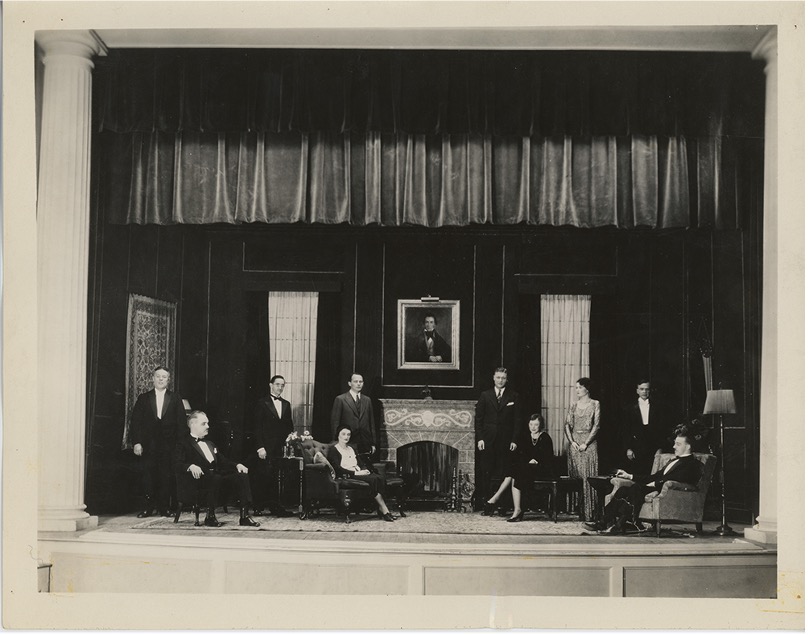
Executive Director Brianna Treleven introduced me to my project: a large fruit-of-the-month box labeled “Dorothy R. Davis, 2005,” which had sat untouched for 20 years. My task was to organize, catalog, create metadata, digitize, and preserve its contents—documents, photographs, and memorabilia from a forgotten community theater troupe, the Shaker Players.
Opening the box revealed a poster for “Strange Bedfellows,” followed by photographs, playbills, clippings, and handwritten notes dating from the 1920s to the mid-1960s. As I cataloged each piece, the story of the Shaker Players emerged. The group began in 1919, founded by Rachel Cochran to raise funds for Plymouth Church with a one-act play, “The Price of Orchids.” Success led to the official formation of the Plymouth Players in 1920, focused on drama education and community engagement.
At her pastor’s suggestion, Rachel renamed the group the Shaker Village Players to reflect its wider community role. By the late 1920s, productions increased, and by 1930 they staged three shows a year. Around 1940, they incorporated as The Shaker Players, Inc., managed by a nine-member board. Funding came from ticket sales, advertising, and membership dues, supplemented by social events.
Newspaper archives revealed frequent mentions in The Plain Dealer, Cleveland Press, and Heights Sun News, particularly during the 1950s, when advertising was robust. Reviews were generally positive, though occasionally blunt, as when Cleveland Press critic Paul Mooney called their first musical, “Say, Darling,” “a drab display of banality” but praised their choral and dance work.
The box also illuminated the role of Dorothy R. Davis, the second woman to serve as president in the troupe’s 40-year history. A World War II lieutenant and advertising copywriter, Dorothy spearheaded the Players’ 40th-anniversary celebration, securing a front-page feature and promoting the season vigorously. She had previously overseen the Studio Theater, which performed one-acts by local playwrights.
Financial records from 1957-58 showed 93% of income from ticket sales, ads, and patron donations, with major expenses going to printing and royalties. By June 1958, the Players had $3,023.02 on hand (about $34,000 today), ensuring a stable future at the time.
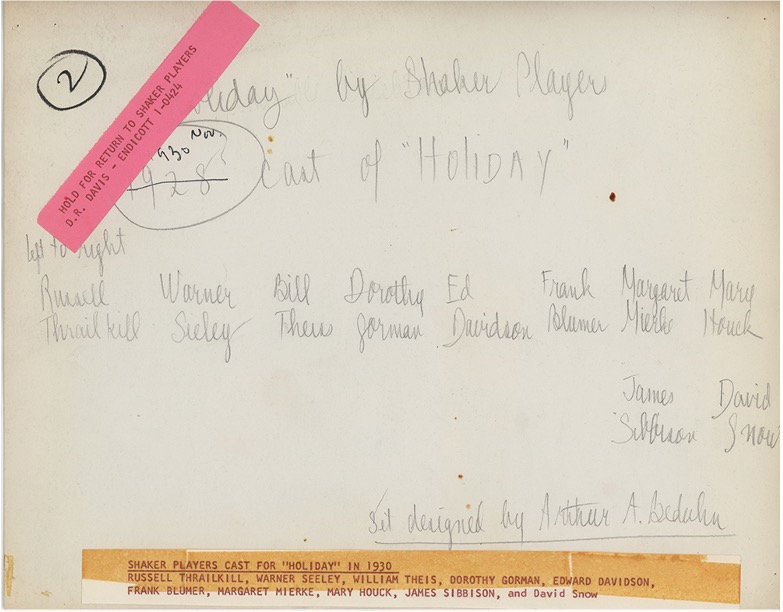
As I reached the bottom of Dorothy’s box, I sorted the collection into five main categories—Ephemera, Newspapers, Organization, Photos, and Marketing—further divided into 15 folders. Duplicates were pared down, photographs placed in mylar sleeves, and a finding aid created with historical background on Dorothy and the Players.
Additional SHS files contained more photographs and documents, but also clues to the group’s fate. Press releases from 1964 announced their final show at Shaker Heights High School, “Anything Goes,” after 45 years in the same venue. Early statements expressed optimism about finding a new home, but later releases struck a more final tone. It appears that the Players disbanded shortly thereafter.
Concluding the project was bittersweet. While I was saddened to learn the Shaker Players likely never found a new home, I was gratified to have pieced together their history from near obscurity. Thanks to Dorothy’s meticulous record-keeping and SHS’s preservation, their legacy now has a permanent place in the historical record.