This summer, I interned at the North Royalton Historical Society’s Museum, the second year I have worked for them. While it is small – staffed by three part-time employees, a few undergraduate interns, and myself – the museum gives us the ability to easily see our contributions bear fruit. At the outset, I hoped to improve upon my work from last year. Even more, I wanted to see a project through from start to finish. I surprised myself when I did just that, although the work will always be ongoing.
I live between ten and fifteen minutes from the James Buckingham Museum, officially called the Smith-Rutledge House, named after both the building’s architect and its first owner. The Historical Society – founded in 1976 by, among others, James Buckingham – purchased the property in 2018. Right now, there are only two officers: Georgia Viehbeck, President of the Society, and Connie Mayer, the Secretary. We are overhauling our bylaws, which will introduce a Board of Trustees, which I said I was willing to serve on at the last general meeting.
Georgia, as President, gave me two projects to complete. Both are “finished,” although it is hard to describe it that way because the research is ongoing. The first was to combine the several, sometimes conflicting timelines of North Royalton history made throughout the years. The oldest was compiled in 1968, done on a typewriter. The newest, completed in 2018, appears on the museum’s outdated website. I had to merge them all into a single, coherent timeline. This proved far harder than expected, though, because many of the cross-checked entries contradict each other. Some of these discrepancies, like the dates of building construction or local government decisions, are very important to how we present our city’s history. I did my best to balance the sources and do my own research to make a new chronology that will hopefully soon be up on a newly designed website. Some periods are thoroughly detailed, like the 1950s, while others, including the post-1989 period, are less fleshed out. I am also dissatisfied at the dearth of information on the area before American settlement; the farthest back reaching timeline begins in 1811. I believe we should recognize the fact that humans have lived in this area for many thousands of years, modern North Royalton’s story representing a small fraction of that, yet this is hard to do with almost nothing written on it. Luckily, we plan in the future to re-examine collections of Indigenous arrowheads to see what people in particular shared this place with us.
The other project is much more complete than it was before I started, but it won’t be totally done until October: our second annual History Walk. Last year, I was one of the presenters on the walk around the City Green, which was open to the public. For this year’s event, I made a more detailed map of our route, while systematically researching information on the stops. Being far more prepared, with a script in my hand and head, I should be more confident and loud while acting as a guide, things I know I needed to improve on. Before the summer ends, I still need to find content for a few properties to make sure I have more than two sentences at those stops. While I was eager to work for the Society as an intern, I think having it as a “job” has motivated me to get these things done well before I “needed” to, thus giving me more time to refine my work. The Historical Society is going to be closed for renovations soon, so getting the work done early has been really important.
Although not one of my official projects, I have also been involved in the Society’s efforts to renovate Pritchard Cemetery, North Royalton’s oldest. This point is another example of local history being murky: Pritchard has been reported in different sources as being founded in 1818, yet other sources say that the first burial took place in 1816. Whatever the true date, it at least dates back to within the first decade of white settlement. Most of the graves are badly weathered, and many of them are broken. It is so bad that we are not entirely sure how many plots there are. Before we can hire a restoration company, we have a lot of work to do applying for grants and arranging fundraising events. I attended an on-site meeting at the cemetery with other Society members, where I offered to contribute to the project by taking photographs, identifying types of damage, and mapping the plots. This will be challenging since almost no records on Pritchard’s planning remain. We expect to fully start on this in October, after the Museum reopens.
While I was busier than expected this summer (not even counting the internship), I am still proud of the progress I made. I have found that I need to work on initiating projects myself, especially if I want to be more involved in the Society’s future. Working with the public is another thing I did not get to do enough of, and that is vitally important if I want to teach in the near future. In terms of self-discipline, becoming more tech-savvy, and finding creative ways to research, this internship has been excellent. It was very worthwhile to have pursued it.
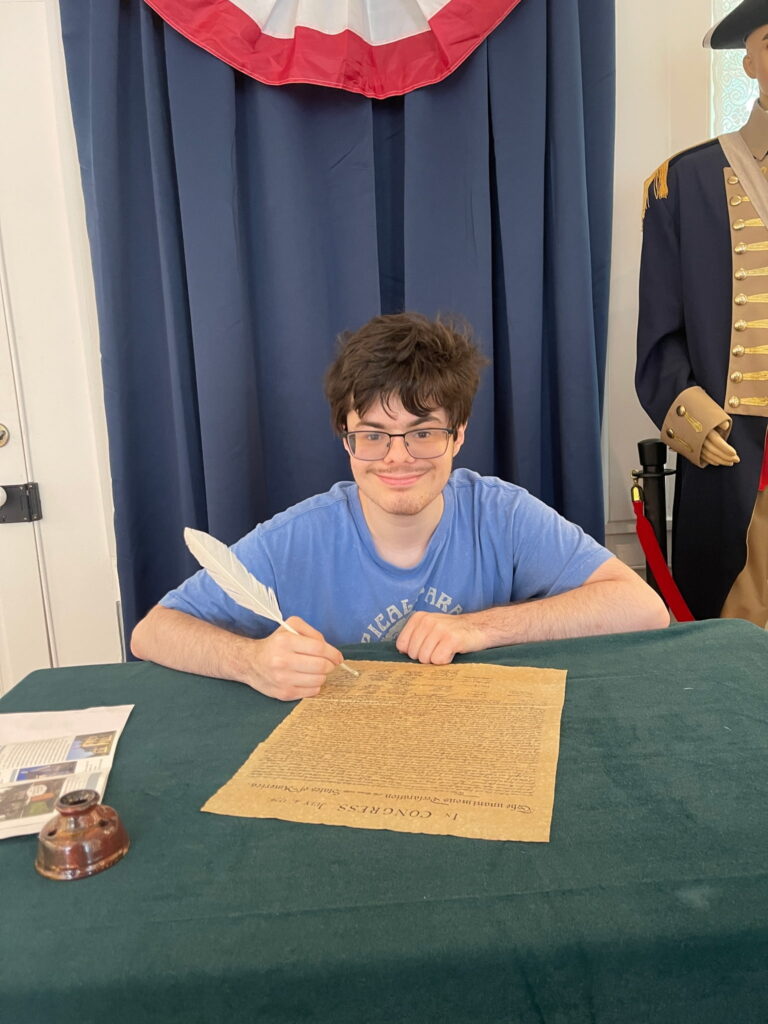
Photo of myself at the Ebenezer Pomeroy House in Strongsville’s Historic Village. This was a special exhibit for the America 250 celebration. Photo by Heidi Michalske
