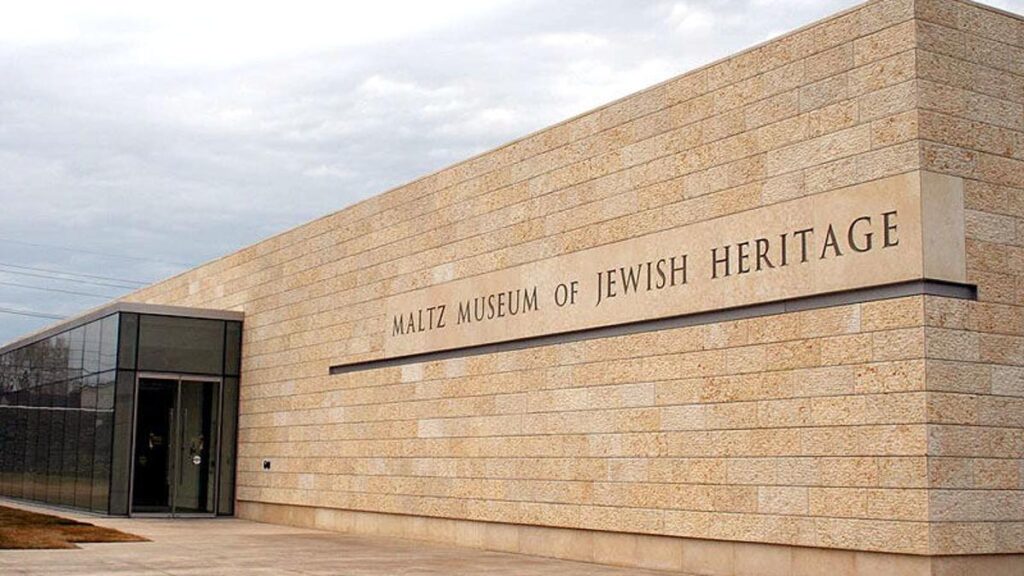
During the Summer 2024 semester, I had the privilege of working as an intern at the Maltz Museum (formerly the Maltz Museum of Jewish Heritage) in Beachwood, Ohio. Located at 2929 Richmond Road, the museum was founded by Milton and Tamar Maltz. The ground breaking ceremony took place in 2003 with the grand opening occurring in 2005. Although the Jewish lived experience in Northeast Ohio titled “An American Story”, beginning with the immigration from Bavaria of a Jewish population to Cleveland in the 1830’s, has always remained at the core of the Maltz Museum, as the new name suggests, the museum has recently reoriented its goals to focus on the “Respect for All Humanity” that is a fundamental value of Judaism. Coinciding with this soft rebranding, one tour that the museum wanted to be refreshed was the Common Threads tour.
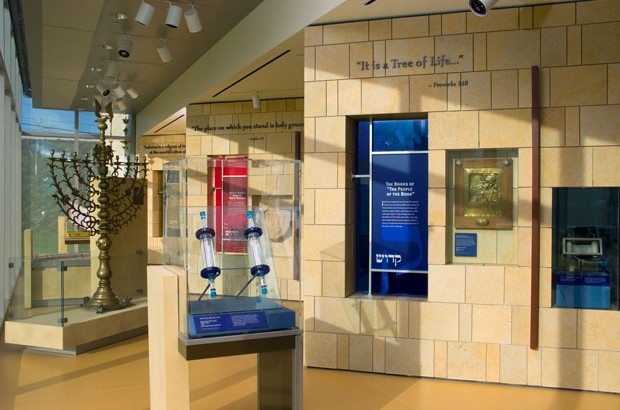
The Common Threads tour was originally created with a specific audience of Catholic school students in mind. There were multiple problems presented by this iteration of the tour. First was that, even if you specifically manufacture a tour towards students that attend Catholic schools, not all of those visiting students will be Catholic. Some of those students may not even be Christian or religious at all and are just attending the Catholic school for the purpose of an education or an opportunity to participate in sports. Trying to ask questions to these students regarding their own religious practices or deep theological questions about what spaces are considered sacred or texts holy could often be met with blank stares or students feeling lost and not connected to the tour taking place. Using the accumulated Judaica displayed in the Temple-Tifereth Gallery, I was tasked with revamping the Common Threads tour to be more widely and easily digestible for all visitors. This meant that the new tour would be based primarily around cultural similarities between religions including art style, location, common themes and materials and some faith-based similarities that were not theologically based as much as they were similar in practice like ritual washing and cleansing and the practice of prayer. Common Threads was meant to be made more anthropological and less theological. Perhaps the biggest change to the tour though was the incorporation of Islam. In accordance with the museum’s emphasis on diversity and respect, the tour was expanded to incorporate commonalities between all three of the Abrahamic religions, not just Christianity (more specifically Catholicism) and Judaism.
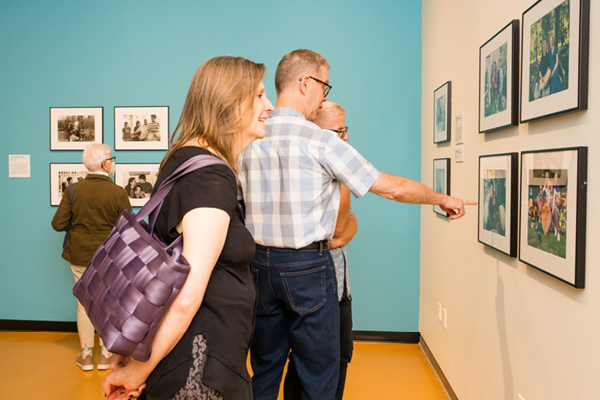
During my internship at the museum, I was supervised by Liz Novak, the Senior Manager of Education at the Maltz Museum. She was my main point of contact in regards to editing the Common Threads tour and providing me feedback concerning the artifacts in the Temple-Tifereth Israel Gallery that I had chosen to highlight in the tour and the main commonalities that I chose to emphasize, using these items, between Judaism, Islam, and Christianity. However, during my period interning at the museum, I got the chance to meet the entire staff and got the opportunity to assist the Manager of Collections and Exhibitions with some physical aspects of the current temporary exhibit the museum is running. This involved placing didactics onto the walls of the space.
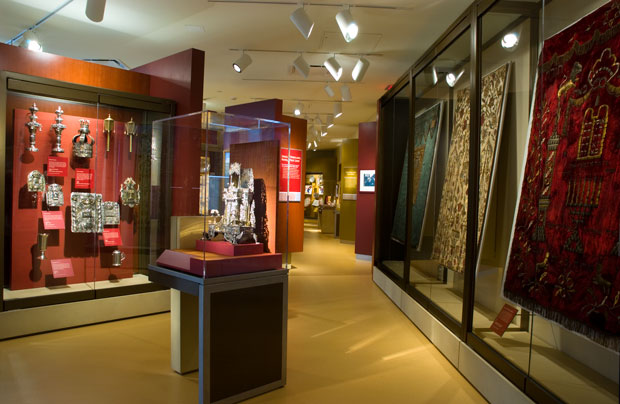
My first task in crafting the Common Threads tour was, I believed, to pick out specific items in the Temple-Tifereth Israel Gallery that would draw the attention of visitors and guests on the tour. I spent most of my time at the museum over first few days of the internship in the Temple Gallery just familiarizing myself with the items in the collection. Liz Novak helped to direct me in picking out the first few objects by observing which of the items were her personal favorites like a Torah ark curtain from Turkey dating to 1700 C.E. and a small glass worked sculpture of a Jewish family gathered around for seder created by Italian artist Gianni Toso. This gave me a launching point for knowing what types of objects were going to compose the backbone of the tour. The Temple-Tifereth Israel Gallery is also divided into three different sections: Sacred Words, Sacred Spaces, and Sacred Occasions. Sacred Words deals with the artistic representations of passages from the Torah and other pieces of sacred scripture. Sacred Spaces relates to the importance of location, both large and small. This section contains a great amount of household Judaica used for carrying out the obligations of Jewish observers and maps of the Palestine region, or the Jewish Holy Land of modern Israel. The final section, Sacred Occasions, presents objects that pertain to important events in Jewish life. Birth, education, religious coming-of-age, marriage, and death are all themes behind the artifacts in this section of the gallery. These three sections of the gallery would also serve as the three different sections of the tour.
However, what I eventually realized after spending some time in the gallery was that I was not approaching this in the correct way. Picking out the objects that stood out to me and then trying to desperately find some sort of commonality between that object, Islam, and Christianity would not create a deeply educational and engaging tour. Instead, I used secondary sources to learn more about the art and objects of primarily Islam and to a lesser degree Christianity. Whenever I noticed commonalities between an aspect of Islam or Christianity and Judaism, like the practice of ritual washing and cleansing before prayer in Islam, after waking up, before eating, and after visiting cemeteries in Judaism, or in rites like baptism in Christianity, I made sure to find a washing vessel in the gallery, even if it was not the most extravagant object on display, and made it one of the highlighted objects in the tour. In the end, this approach of determining these engaging commonalities and then finding objects within the gallery’s collection to visually support these commonalities proved to be much more effective in creating a tour. As much as we may want a tour of a museum to be highlighted by the most fantastic and flamboyant artifacts, I quickly discovered that there must be a balance between the artifacts and the themes that they represent.
It was also during this period in which I had the incredible opportunity and the privilege to take a tour through the Temple-Tifereth Israel Gallery with the Temple’s Museum Director Dr. Katya Oicherman. Dr. Oicherman both confirmed my understanding of the direction that I needed to take the Common Threads tour in while also providing me with numerous examples of the commonalities between some of the artifacts in the collection and with the other Abrahamic religions. One of the most significant examples of this was her explanation of how a Turkish Torah ark curtain, created for the purpose of obscuring the storage compartment of a Torah scroll, bore numerous motifs taken from Islamic art. Although a piece of Judaica, the embroidered designs were twisting flowers and vines decorating the common aspects of a Torah curtain like the columns of Solomon’s Temple, effectively combining Islamic art with Judaic art. Having the opportunity to spend this time with such a wealth of knowledge as Dr. Oicherman was both an honor and elucidating as I continued my progress on designing the tour.
In my time at the Maltz Museum I learned a great amount about how world-renowned museums operate as an institution and how my skills can be applied. Upon my final day at the museum, I completed the core of the new Common Threads tour. Liz will continue to expand upon it with questions to ask of visitors on the tour. In sum, the experience was supremely beneficial in a variety of ways. It provided me with valuable experience in a museum setting, allowed me to apply my skills and abilities, and the staff at the museum embraced my internship there so warmly that I can only hope that my work on the Common Threads tour can begin to repay the experience that they provided me.
